


Haunted House Survival Guide: What to Expect
Updated: Aug 13
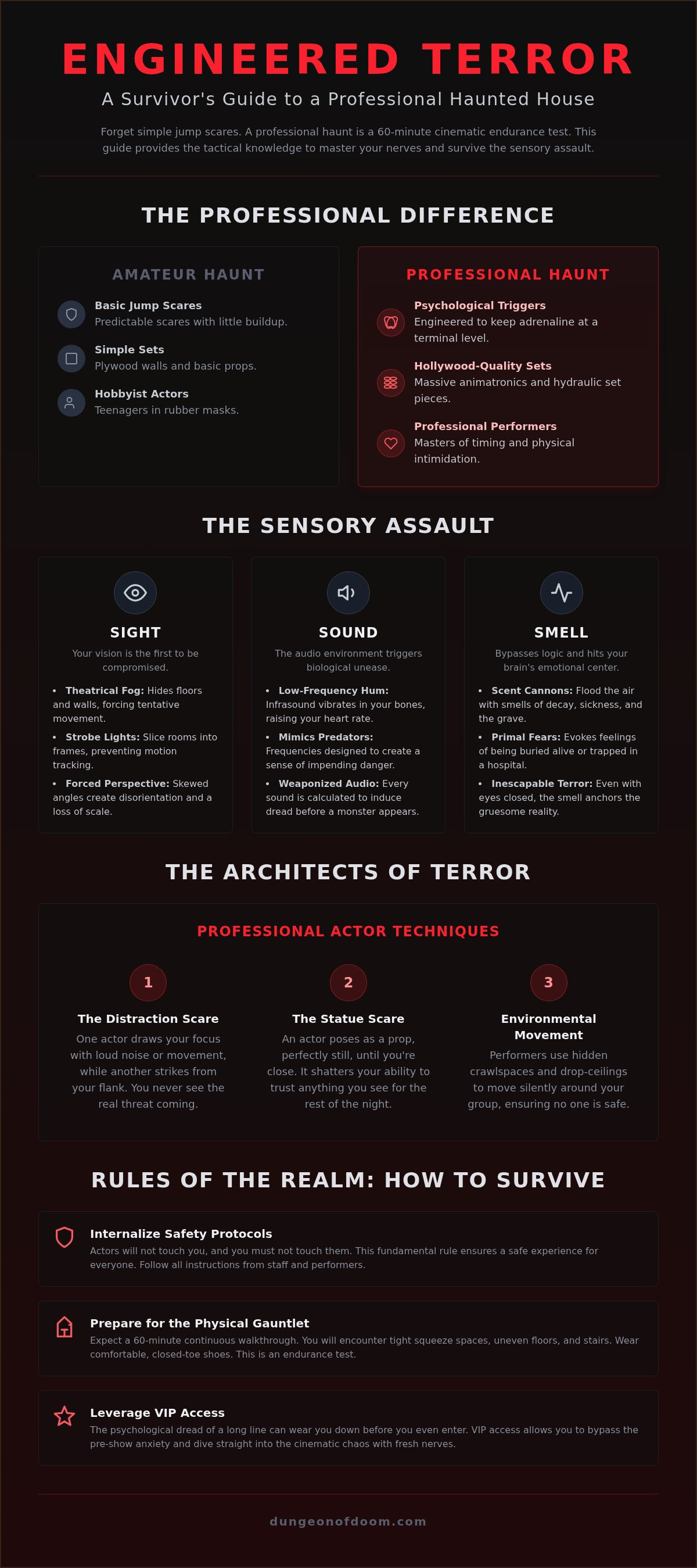
A professional haunted house is a cinematic endurance test, not a simple series of jump scares. Your pulse quickens. The air grows heavy with the scent of ozone and decay. You aren't just paying for a walk through the dark; you're entering a high-octane experience engineered by masters of the macabre since 1997. Understanding what to expect at a haunted house is the only way to transform from a trembling target into a seasoned survivor. It's natural to feel overwhelmed by the unknown, fearing you'll be the one who breaks under the pressure of Hollywood-quality sets and relentless psychological triggers.
We know the dread. We've watched millions of visitors face the sensory assault of a 60-minute continuous walkthrough. This guide provides the tactical knowledge you need to master your nerves and understand the professional safety protocols protecting you. You'll learn how to navigate the chaos, manage sensory overload, and why a VIP ticket is your best weapon against the pre-show anxiety of the crowd. Prepare to face the darkness with total confidence and emerge with your nerves intact.
Table of Contents
The Sensory Assault: Sight, Sound, and Smell
Step into the dark. The world outside dies. A professional haunted attraction is more than a walkthrough; it's a coordinated sensory assault designed to shatter your composure. This isn't a casual stroll. It is a weaponized environment where every smell, sound, and shadow is calculated to induce dread. When you consider what to expect at a haunted house, realize that your five senses are the first things to be compromised. You are no longer in control.
The air is thick. Theatrical fog chokes the corridors, turning the atmosphere into a heavy, grey soup. It's not just for effect. It creates a physical barrier that hides the floor and the walls, forcing you to move tentatively into the unknown. Beneath the audible screams, low-frequency audio hums. This infrasound vibrates in your bones, triggering a deep, biological unease that your mind cannot explain. Your heart rate climbs before you even see a monster because your body is reacting to frequencies designed to mimic the presence of a predator.
Visual Disorientation and Strobe Effects
Lighting designers are architects of the abyss. They don't just use darkness; they use it to manipulate your movement and hide the predators waiting for you. Intermittent flashes from high-intensity strobes slice the room into disconnected frames. This prevents your eyes from tracking motion, allowing actors to move invisibly between the pulses of light. Your vision never truly adjusts to the shifting shadows. Forced perspective is another tool in the arsenal. Rooms are built with skewed angles, making hallways feel miles long or ceilings feel like they are crushing down on your skull. You lose your sense of scale. You lose your sense of safety.
The Olfactory Layer: Why Haunts Smell Different
Smell is the only sense with a direct line to the brain's emotional center. It bypasses logic and hits your memory like a physical blow. High-end productions use scent cannons to flood the air with the stench of swamp water, antique dust, or medicinal chemicals. These aren't accidents. They evoke primal fears of decay, sickness, and the grave. You might smell damp earth and suddenly feel buried alive. Scent cannons are used to anchor the gruesome reality of a set by forcing your brain to accept the environment as a physical, breathing space. This layer of detail ensures that even if you close your eyes, the terror remains inescapable. Understanding what to expect at a haunted house means accepting that every breath you take is part of the show.
The Architects of Terror: Actors and Hollywood-Quality Sets
Forget the amateur tropes. When you consider what to expect at a haunted house, discard the image of a teenager in a rubber mask. Professional haunts have evolved into cinematic battlegrounds. Building on the sensory assault, the physical environment itself becomes a predator. We've moved past "black wall" attractions where plywood and spray paint were the standard. Now, you walk through living nightmares built with Hollywood-quality precision. Every corner tells a story of decay, much like the atmospheric settings described in Graham Mulvein's World of Horrors. Every shadow is a calculated void designed to swallow you whole.
The terror is driven by a live cast of professional performers. These aren't hobbyists; they are masters of timing and physical intimidation. They understand the psychology of being scared and how to exploit your specific vulnerabilities. While a jump scare provides a momentary spike, environmental storytelling keeps your adrenaline at a terminal level. Massive animatronics and hydraulic set pieces add a scale of danger that feels impossible to escape. Imagine a ceiling that drops six inches in a heartbeat or a floor that tilts as you cross it. The machines don't get tired, and they don't miss their cues.
The Art of the Scare: Actor Techniques
Professional performers use the environment as a weapon. They don't just stand in doorways; they inhabit the set. They know exactly where your eyes will go and they wait in the blind spots created by your own fear.
The Distraction Scare: One actor draws your attention with a loud noise or movement while another strikes from your flank. You never see the real threat coming.
The Statue Scare: You stare at a prop, convinced it's plastic. Then it breathes. This psychological toll ruins your ability to trust anything you see for the rest of the night.
Environmental Movement: Actors utilize hidden crawlspaces and drop-ceilings to move silently around your group. This ensures no one is ever truly "safe" at the back of the line.
Hollywood-Level Production in the Midwest
Legacy haunts in Zion, IL, prove that you don't need a California zip code for world-class horror. These sets are constructed from reclaimed materials-heavy timber, rusted iron, and weathered stone-to provide an authentic, gritty texture that paint cannot mimic. This is exactly what to expect at a haunted house that has been perfecting its craft since 1997. Every light flicker and sound cue is synced to the movement of the crowd through sophisticated automation. It is a relentless, automated symphony of chaos. If you think you've seen it all, you haven't faced the Dungeon of Doom.
Rules of the Realm: How to Survive the Walkthrough
The darkness isn't lawless. It's a calculated trial. To survive the night, you must respect the boundaries of the abyss. The Golden Rule is absolute: you do not touch the actors, and they do not touch you. This boundary is the thin line between a professional production and total chaos. When you understand what to expect at a haunted house, you realize these rules aren't there to limit your fun. They exist to preserve the immersion. Violation of this code is the fastest way to find yourself escorted to the exit by security.
Prohibited items are strictly enforced for the safety of the cast and the integrity of the sets. Flashlights and cameras are banned because they shatter the lighting design and spoil the scares for others. Alcohol is a liability. It dulls your reflexes and increases the likelihood of accidental contact. If you reach your breaking point, don't stop in the middle of a corridor. Look for a staff member or yell that you are "checking out." There is no shame in it; the psychology of fear explains that everyone has a different threshold for sensory overload. We have protocols in place to extract you safely without disrupting the flow for the rest of the group.
The "No Touch" Policy Explained
This is the foundation of the experience. Professional performers are trained in "near-miss" techniques. They will get close enough for you to feel the heat of their breath or the wind of their movement. It feels like an assault, but it's a precision-engineered illusion. If you lash out or try to initiate contact, you break the spell. You also risk injuring a performer or yourself. In a high-octane environment, any intentional contact is treated as a security threat. Keep your hands in. Keep your eyes open.
Survival Etiquette for First-Timers
Your position in the group dictates your experience. The person at the front is the scout; they trigger the sensors and take the first hit of every scare. The person at the back is the anchor; they are the primary target for actors who stalk the group from behind. Choose your place wisely.
Keep the line moving: Stopping creates "conga lines" that ruin the pacing. Move forward, even when you're terrified.
Don't taunt the cast: If you try to act "too cool" or mock the actors, you've just signed your own death warrant for the night. You will become their singular focus.
Follow the light: Hidden floor lights and subtle directional cues guide you through the darkness. Straying from the path leads to physical hazards or dead ends.
Knowing what to expect at a haunted house means respecting the craft. Follow the path. Respect the cast. Survive the hour.
The Physical Gauntlet: Endurance and the Walkthrough
The terror is physical. It isn't just in your head; it's in your legs, your lungs, and your balance. A legendary attraction doesn't offer "safe zones" or mid-point exits. Once you cross the threshold, you are committed to a continuous walkthrough. This is a relentless journey through uneven floors, steep stairs, and claustrophobic "squeeze" spaces that challenge your composure. Understanding what to expect at a haunted house involves recognizing that your endurance is as much a part of the show as the actors themselves. You will climb. You will crawl. You will push through the dark.
When planning what to expect at a haunted house of this caliber, realize that most commercial haunts are over in fifteen minutes. They are sprints. A Zion legend since 1997, however, sets the industry gold standard with a 60-minute continuous walkthrough. This duration is designed to exhaust your psychological defenses. By the forty-minute mark, your adrenaline levels begin to plateau; that is when the real dread sets in. You aren't just a visitor; you're a survivor in a cinematic marathon. This scale provides massive value for your ticket price, ensuring the nightmare lasts long enough to feel real. After completing such a marathon, you can discover Gotham Cigars to find a high-quality cigar to help you decompress from the hour-long ordeal.
Timing the Terror: How Long Does it Last?
Pacing is a dark art. Professional performers manage the flow of the crowd to ensure you never feel the safety of numbers. They speed you up or slow you down to prevent "clumping," keeping your group isolated in the dark. This sixty-minute journey allows for a complete adrenaline arc, moving from initial shock to deep, sustained paranoia. It’s the difference between a cheap thrill and a total immersive experience. In a shorter house, you can hold your breath. Here, you have to find a rhythm to survive.
Physical Prep: Shoes and Clothing
The environment is gritty. These are industrial-grade sets, not carpeted hallways. Sturdy, closed-toe footwear is mandatory. You will navigate stairs and narrow passages where loose clothing or dangling jewelry can become a hazard. Leave the valuables in the car; avoid wearing loose jewelry or items that can be easily dropped in the dark. If you lose a phone or a ring in a 60-minute labyrinth, the abyss keeps it until the lights go up at the end of the season.
The Chicago and Milwaukee autumn is unforgiving. You will likely wait in an outdoor queue before entering the climate-controlled chaos of the house. Layer your clothing. You'll sweat from the heat of the hydraulic machinery and the sheer exertion of fear, but you'll freeze in the Zion wind outside. Prepare for both extremes. To bypass the wait and the weather, purchase VIP Tickets to get inside the action faster and keep your adrenaline focused on the walkthrough rather than the cold.
Face Your Fears at the Dungeon of Doom
Zion's industrial heart beats with a specific kind of malice. Since 1997, the Dungeon of Doom Haunted House has stood as a titan in the industry, an authoritative legend that has spent nearly 30 years perfecting the art of the nightmare. This is the birthplace of visceral, high-octane terror for the Chicago and Milwaukee areas. When you research what to expect at a haunted house, you'll find plenty of local mazes that last fifteen minutes. We don't do fifteen minutes. We offer a 60-minute continuous walkthrough that serves as a brutal test of your psychological and physical endurance. You aren't just a visitor; you're a survivor in a cinematic marathon.
The legacy isn't just about the time spent inside. It's about the standard we set. We utilize Hollywood-quality sets and a professional cast of actors who live and breathe this craft. This is the "Dungeon Family." They are a relentless force dedicated to your total immersion. They don't just scare; they haunt. Every corridor is a cinematic set piece designed to make you forget the world outside exists. You aren't just walking through a building; you're surviving a trial of nerves where the environment is as dangerous as the creatures within it.
The Legacy of the Dungeon
Nearly three decades of operation has transformed us into a seasoned veteran of the macabre. We have pushed the boundaries of what a haunted attraction can be, moving from simple jump scares to complex, story-driven environments. Our commitment to high-end production values ensures that every visit feels like stepping into a big-budget horror film. The scale is massive. The impact is visceral. This is why we remain a premier destination for those who seek more than just a seasonal thrill. We are the architects of your deepest dread.
Planning Your Visit in 2026
The 2026 season promises to be our most intense yet. Do not wait until the Saturday before Halloween to decide your fate; that is when the crowds are thickest and the anxiety is highest. Secure your spot early. General Admission Tickets get you into the gauntlet, but for those who want to bypass the pre-scare dread of the line, VIP Tickets are the only logical choice. You skip the wait. You head straight into the abyss. Planning ahead ensures you have the mental energy required to face the 60-minute gauntlet without distraction.
The fear you feel standing at the gate is the most honest emotion you'll experience all year. Lean into it. That racing heartbeat and the sudden shock of the unknown are why you are here. You now know exactly what to expect at a haunted house that takes its legacy seriously. The only thing left to do is face it. Book your tickets for the 2026 season at Dungeon of Doom Haunted House and prepare for the journey that will redefine your understanding of terror. Your nerves are the only thing standing between you and the exit.
Survive the Night in Zion
The transition is complete. You have moved from a trembling target to a tactical survivor. You understand the sensory assault. You respect the rules. You are ready for the 60-minute continuous walkthrough that has defined the Zion landscape since 1997. Knowing what to expect at a haunted house is your only armor against the cinematic chaos waiting within the abyss. This is more than a seasonal thrill; it's a trial of endurance perfected over 25 years of professional scares. The air is cold. The machinery is humming. The actors are waiting.
Don't hesitate at the threshold. The fear you feel is the adrenaline you came for. Master your nerves and step into the legacy of the Midwest’s most formidable attraction. Your survival depends on your confidence. Secure your 2026 tickets for the Midwest’s most intense haunted house and prove you have what it takes to finish the hour. We’ll be waiting in the shadows. See you on the other side.
Frequently Asked Questions
Will the actors touch me at a haunted house?
No, professional performers will not touch you. They are trained to use spatial intimidation and "near-miss" timing to make you feel vulnerable without breaking the physical boundary. This rule protects both the guest and the actor. If you maintain your composure and keep your hands to yourself, the experience remains a safe, high-octane trial of nerves. Respect the boundary to keep the nightmare moving.
How long does a typical haunted house walkthrough take?
Duration varies by location, but a top-tier attraction provides an hour-long ordeal. When considering what to expect at a haunted house, realize that most small-scale haunts last only 15 minutes. A 60-minute continuous walkthrough is the industry gold standard for immersion. This extended length is designed to wear down your psychological defenses, ensuring the adrenaline doesn't peak until you are deep within the industrial sets.
What should I wear to a haunted house?
Wear durable, closed-toe shoes and practical layers. You will navigate industrial sets with uneven floors and tight passages where flimsy footwear is a liability. Avoid loose jewelry or expensive items that can be lost in the darkness. Because you'll face both the Zion autumn wind in the queue and the high-energy heat of the machinery inside, layering is the only way to maintain your focus on the terror.
Can I leave a haunted house early if I get too scared?
Extraction protocols exist for those who cannot finish the gauntlet. If the sensory assault becomes unbearable, signal a staff member or yell for assistance to be removed. You will be escorted to the nearest exit immediately. There is no shame in hitting your breaking point; it happens to thousands of visitors every season who underestimate the psychological pressure of a professional-grade production.
Are haunted houses safe for people with medical conditions?
High-intensity haunts are not recommended for individuals with certain medical conditions. The environment utilizes strobe lights, theatrical fog, and low-frequency audio that can trigger seizures, asthma, or heart complications. If you have a history of these issues, consult a medical professional before entering. Your safety is maintained through strict fire codes and professional oversight, but the physical strain on your heart and lungs is real.
What is the best age for a haunted house?
Mature audiences, typically ages 12 and up, get the most out of the experience. The psychological triggers and visceral imagery are engineered for adult nerves. While there is no universal age limit, parents should understand what to expect at a haunted house before bringing younger children. If a child cannot handle intense darkness and loud, aggressive performances, they are not ready for a legendary Zion walkthrough.
What happens if I accidentally touch an actor?
Intentional or accidental contact with actors is handled immediately by security. If you lash out in a moment of panic, the walkthrough may be paused to assess the situation. Intentional physical aggression toward our cast results in immediate ejection without a refund. Keep your hands in and your reflexes in check. The performers are professionals; treat them with the same respect they show your personal space.
Is there a difference between General Admission and VIP tickets?
The primary difference is wait time and psychological fatigue. General Admission Tickets provide the full cinematic journey but involve waiting in the standard queue. VIP Tickets are designed for those who want to skip the line and dive straight into the abyss. By bypassing the long wait, you preserve your adrenaline for the actual walkthrough and avoid the pre-show anxiety that builds in the outdoor elements.
Comments