


Immersive Haunted House Experience: The Science behind Cinematic Dread
Most haunted attractions aren't actually scary; they're just loud. You waste your money on five minute sprints through cardboard walls, missing the depth of a truly immersive haunted house experience. You leave feeling cheated by campy execution. It's frustrating to seek a genuine thrill and find nothing but cheap gimmicks. You want a descent into madness that feels permanent. You want the adrenaline. The dread. The impact.
Real horror isn't about being touched by a stranger in a dark hallway. It's about cinematic dread. Since 1997, the standard has been set by veterans who treat horror as a professional craft. This article explores the high-end production and psychological endurance required to survive 2026's most intense scares. You'll discover the tech behind Hollywood-quality sets, the training of elite scare actors, and why a nearly one-hour continuous walkthrough is the only way to achieve total immersion. Prepare for the 30th anniversary of elite terror. We're stripping away the masks to reveal the science of cinematic dread.
Table of Contents
What is an Immersive Haunted House Experience?
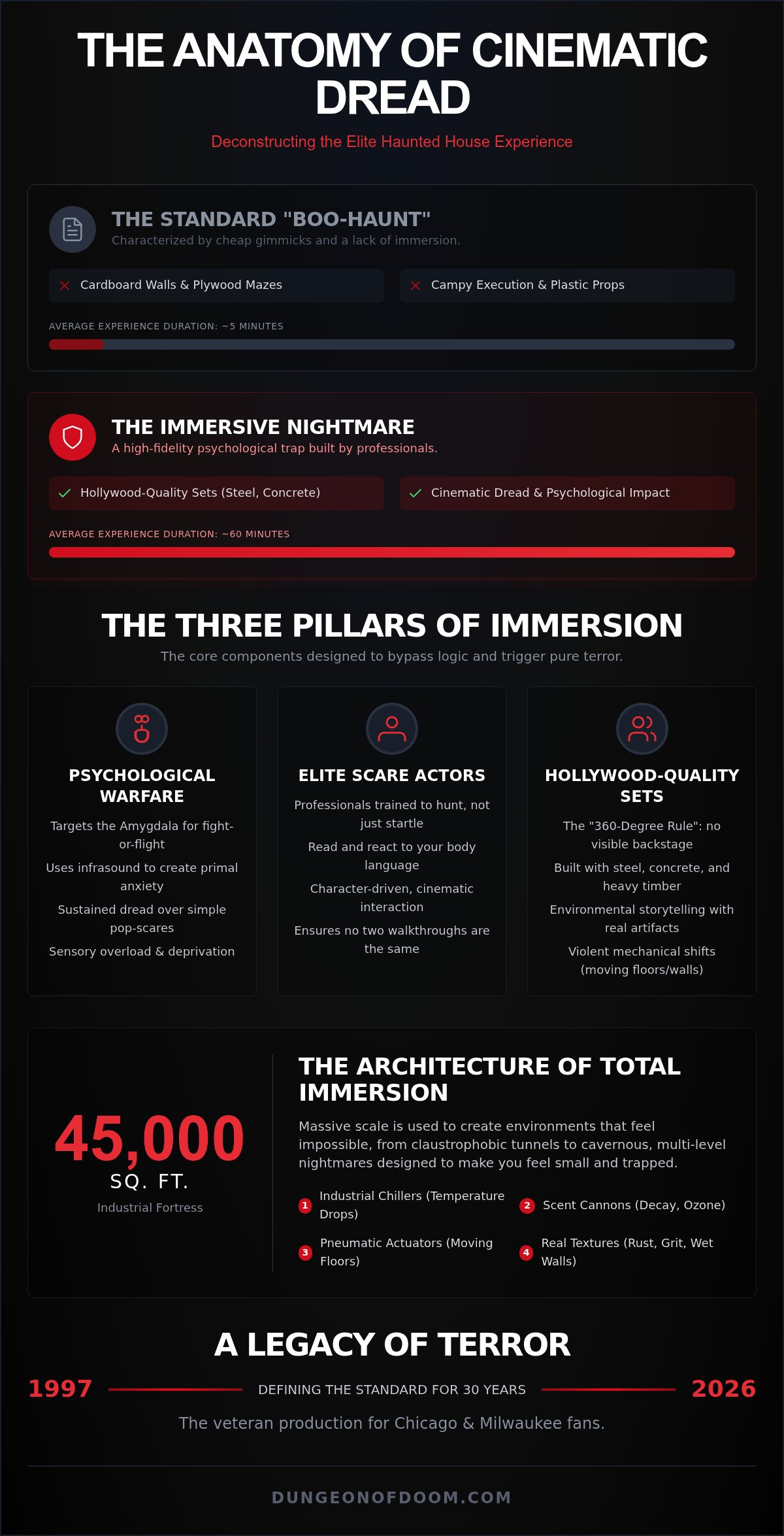
Stop thinking about plastic masks. Forget the plywood mazes of your youth. A true immersive haunted house experience is a high-fidelity psychological trap designed to bypass your logic. It targets the amygdala. It forces your brain into a raw state of fight or flight. By 2026, audiences have seen it all. They're desensitized. They demand scale. They demand realism. This is why the industry has shifted from campy "boo-haunts" to professional, narrative-driven haunted attraction environments. We use sensory overload to crush your resolve. We use sensory deprivation to make you feel utterly alone. You aren't just walking through a set. You're surviving a cinematic nightmare.
The Psychology of Sound and Lighting
Sound is a weapon. We use infrasound; it's a frequency you can't hear but your body feels. It triggers primal anxiety and a sense of impending doom. Directional audio makes you think something is breathing on your neck when the room is empty. Lighting isn't for visibility. It's for control. We use shadow to dictate where you look. We hide our threats in the dead zones of your vision. This creates sustained dread rather than simple startle-responses. A pop-scare is a blink. Sustained dread is a cold sweat that lasts for the entire walkthrough. It's the difference between a quick shock and a total psychological collapse.
Live Actors: The Heartbeat of the Horror
Actors are the heartbeat of the terror. They aren't just jumping out of boxes. These are professional predators. They read you. They watch your body language in the dark. They find the person in your group who is trembling and they strike. This character-driven interaction is what separates a professional immersive haunted house experience from a backyard show. It takes hours of training to maintain a cinematic persona while tracking your every move. They don't just scream. They hunt. They react to your fear in real time, ensuring that no two walkthroughs are ever the same. You're the protagonist in a story that wants to consume you.
The Architecture of Terror: Hollywood-Quality Set Design
A set is not a backdrop. It's a predator. In a truly immersive haunted house experience, the architecture is what separates the legends from the amateurs. We build according to the 360-degree rule. There are no seams. No visible "backstage." No safety nets for your eyes to rest on. If you look up, you see a rotting ceiling. If you look down, you see blood-soaked floorboards. This total visual lockdown is what defines our production, convincing your lizard brain that there is no exit and no hope of rescue.
We break the fourth wall by using your own senses against you. We use industrial chillers to drop the temperature in a "morgue" until you can see your breath. We use scent cannons to blast the smell of ozone, decay, and damp earth into your path. Texture matters. You'll feel the grit of real rust and the slickness of wet walls as you navigate the dark. Engineering takes it further. We use pneumatic systems and heavy-duty actuators to create moving floors and walls that feel like they're closing in. These aren't simple vibrations. They are violent, mechanical shifts that force you to fight for your balance.
Cinematic Scale in Zion
Our Zion location isn't a temporary tent. It's a 45,000 square foot industrial fortress positioned perfectly for fans from Chicago and Milwaukee. We use this massive volume to create environments that feel impossible. You'll transition from claustrophobic, chest-crushing tunnels into cavernous, multi-level nightmares. "Hollywood-quality" isn't a marketing buzzword here. It means we use the same materials found on professional film sets. Steel. Concrete. Stone. The scale is designed to make you feel small and completely trapped. By utilizing this massive industrial space, we trigger the psychology of fear through sheer architectural dominance.
The Illusion of Reality
We ground the horror in a believable history by incorporating real-world artifacts. We don't use plastic props from a party store. Environmental storytelling is the art of making the room tell the story before an actor even appears. A rusted surgical tray or a stack of yellowed papers isn't just clutter; it's evidence of the atrocities that occurred before you arrived. High-traffic walkthroughs require high-impact materials. We build for durability because the terror is relentless. We use heavy timber and reinforced steel to ensure the nightmare remains solid under the pressure of thousands of guests. If you're ready to see what 30 years of design legacy looks like, you should check out our VIP tickets for the full experience.
Immersive vs. Extreme: Understanding the Spectrum of Horror
Physical contact is a crutch. Many attractions rely on "extreme" tactics, grabbing and pulling guests to compensate for weak sets and poor acting. But true immersion ends where physical violation begins. An immersive haunted house experience should be a cinematic endurance test, not a legal liability. When you know you won't be touched, your brain stops worrying about physical safety and starts believing the nightmare. This psychological safe space allows you to sink deeper into the fantasy. You aren't bracing for a pinch; you're bracing for the unknown. Extreme haunts often suffer from "consent fatigue," where the constant physical interaction breaks the story. We prioritize the narrative.
The "five-minute shock" model is dead. It's a series of jump-scares with no pacing. We trade that for a nearly one-hour continuous walkthrough. This is about sustained dread. It's about the exhaustion of your nerves. By the 40-minute mark, your adrenaline is depleted. Your defenses are down. That's when the real horror starts. It's a marathon of the macabre that tests your mental fortitude rather than just your ability to take a shove.
Why 'No-Touch' Doesn't Mean 'No-Fear'
Fear is about anticipation. Our actors are masters of the "near-miss." They use space to dominate you. They move within inches of your face, their breath cold on your skin, but they never break the fourth wall. This keeps the cinematic integrity intact. There are no safety resets. No awkward pauses. We use isolation and total darkness to trigger your brain's internal panic. A hand on your shoulder is a reminder of reality. A shadow moving just out of sight is a promise of something far worse. It's the art of the implied threat. It's more effective than any grab because your imagination fills in the gaps with your own worst fears. If you appreciate this focus on atmosphere and storytelling, you can learn more about Sisters Grimm Ghost Tours to see how historical mysteries create a similarly chilling effect.
Choosing the Right Intensity for Your Group
Not everyone can handle a 60-minute trial. You must assess your group's scare tolerance before you step through the gate. If you're bringing people who freeze at the first sign of a strobe light, prepare for a long night of psychological pressure. For those who live for the rush, VIP access is the only logical choice. It keeps the adrenaline high by removing the wait and keeping you in the mindset of the hunt. You move from the cold reality of the street straight into the heart of the machine. Immersive haunts aren't just about individual fear; they're about shared survival. You'll leave Zion with memories that don't fade. You'll leave with a new understanding of what your nerves can actually handle when pushed to the limit.
Survival Guide: How to Handle a One-Hour Continuous Walkthrough
This is not a five-minute sprint through a parking lot tent. You are entering the longest haunted house walkthrough in Illinois. A nearly sixty-minute descent into a professionally engineered nightmare. To survive an immersive haunted house experience of this magnitude, you must distinguish between theatrical danger and actual safety. The environment is designed to be hostile. It is designed to be relentless. We use pacing as a psychological weapon, alternating between suffocating silence and violent sensory overload to keep your nervous system in a state of constant agitation.
The "mid-way fatigue" is a documented phenomenon we've perfected since 1997. Around the 30-minute mark, your initial adrenaline surge begins to crater. Your brain attempts to rationalize the horror to save energy. This is exactly when our attraction is designed to break your resolve. We pivot from atmospheric dread to high-intensity confrontation. If you haven't prepared for the duration, this is where you'll freeze. You need mental fortitude to push through the second half of the trial when your body is screaming for the exit.
Physical Preparation and Logistics
Treat this walkthrough like a high-stakes athletic event. The industrial floors of our 45,000 square foot fortress in Zion are unforgiving. Wear sturdy, closed-toe footwear with actual grip. Leave the heels and flip-flops at home; you'll be navigating uneven terrain and narrow passages in near-total darkness. Hydration is mandatory. You will be sweating from both movement and pure cortisol. For fans driving in from Chicago or Milwaukee, plan to arrive at least 45 minutes before your scheduled entry. Use that time to disconnect from the outside world and let the dread settle in. You want to enter the gate with your flight-or-fight response already primed.
The Unspoken Rules of the Abyss
Immersion is a two-way street. To get the most out of the professional cast, you must play your part in the story. Don't touch the actors, but don't ignore them either. Taunting actors is the fastest way to become their primary target for the next hour. They are trained to sniff out false bravado and exploit it. If a member of your group hits a genuine breaking point, look for the illuminated exit signs or signal a staff member immediately. We maintain a professional environment, but the terror is real. Once you tap out, there is no re-entry. You either finish the trial or you vanish into the night.
Don't let the 2026 season pass you by without testing your limits. Secure your General Admission tickets today and see if you have the endurance to survive the full hour.
Legacy of the Legend: Why Dungeon of Doom Sets the Standard
Longevity is the ultimate proof of power. Since 1997, Zion has been the epicenter of Illinois horror. We don't just follow trends; we engineer them. While newer attractions scramble to find their identity, we've spent three decades perfecting the art of cinematic dread. This isn't a local hobby. It's a professional-grade institution that has evolved from a regional secret into a nationally recognized powerhouse. We've survived because we refuse to compromise. We don't do cheap masks. We don't do "boo-haunts." We provide a massive, visceral immersive haunted house experience that challenges the very definition of fear. Our location in Zion serves as the perfect "dead zone" middle ground, drawing the most hardcore fans from both Chicago and Milwaukee into our 45,000 square foot industrial nightmare.
The commitment to quality is what defines our legacy. We favor heavy, high-impact materials and complex set pieces over digital projections or simple jump-scares. This dedication to the craft ensures that every corner of the facility feels lived-in and dangerous. You aren't just visiting a set; you're trespassing on sacred ground for the macabre. Our reputation is built on the sweat of over 90 professional actors and three decades of "scare-engineering" that newer haunts simply cannot replicate.
Nearly 30 Years of Nightmares
The 2026 season marks our 30th anniversary. It's a milestone of terror. To celebrate three decades of dominance, we've introduced "Warehouse 30," a massive renovation that pushes our engineering limits further than ever before. You can buy tickets online for this immersive haunted house experience to witness the evolution of the continuous walkthrough. This model is our signature. It requires precise timing to maintain a seamless flow of dread. Fans return year after year because they know the "Dungeon" atmosphere is unmatched. It's a heavy, oppressive energy that stays with you long after you leave the building. We don't just scare you. We change you.
Your 2026 Season Destination
Planning your descent is simple. Our fortress at 600 29th Street is easily accessible via major transit routes from both the Chicago and Milwaukee metros. The 2026 season officially opens Saturday, September 26, at 7:00 PM. Don't wait for the box office. General Admission, VIP, and Special Event tickets are available online, offering you the best chance to secure your spot in the abyss before we hit capacity. VIP tickets are the premier choice for those who demand the ultimate immersive experience without the wait. Join the legacy that has defined the industry for thirty years. Secure your 2026 tickets now and find out why the Dungeon of Doom remains the undisputed master of cinematic dread.
Claim Your Place in the Nightmare
The line has been drawn. You now understand that a true immersive haunted house experience isn't found in a temporary tent or a five-minute sprint. It's engineered. It's a calculated assault on your senses that demands Hollywood-quality production and extreme psychological endurance. You've seen how the 360-degree rule and environmental storytelling turn an industrial warehouse into a living, breathing nightmare. You know the difference between being physically touched and being truly, psychologically hunted.
Since 1997, we've refined this craft in Zion. We've built a legacy on a nearly one-hour continuous walkthrough that breaks your resolve and tests your mental limits. The 2026 season is your invitation to a trial of nerves. Don't settle for campy distractions when you can experience the pinnacle of cinematic dread. Your survival isn't guaranteed; the adrenaline is. Step out of the light and into the machine. The abyss is waiting for you to blink. Prove you have the fortitude to finish what you start.
Face the Abyss: Buy Your Dungeon of Doom Tickets Online
Frequently Asked Questions
What exactly is an immersive haunted house experience?
An immersive haunted house experience is a high-fidelity horror environment designed to bypass your logic and trigger a raw fight-or-flight state. We use 360-degree sets and narrative-driven walkthroughs to remove the seams of reality. Unlike campy "boo-haunts" that rely on plastic masks, this professional model uses cinematic dread and sensory overload to keep you in a state of sustained danger. It's a visceral trial where you are the protagonist.
How long does the Dungeon of Doom walkthrough actually take?
The walkthrough takes nearly one continuous hour to complete. This is one of the longest haunted house experiences in the nation, specifically designed to test your psychological endurance and physical resolve. There are no breaks or safety zones once you enter the gate. We've engineered the pacing since 1997 to ensure the tension builds relentlessly until the final second. It's a marathon of terror that leaves your adrenaline fully depleted.
Is the Dungeon of Doom too scary for kids?
We do not offer child-friendly no-scare tours. Our production is visceral and unapologetically dark, targeting an audience that craves genuine adrenaline. While we don't have a mandatory age limit, the nearly hour-long duration and Hollywood-quality scares are often too intense for younger children. Parents must use their own discretion. This is a professional-grade trial of nerves, not a playground, and we never compromise our intensity for a younger demographic.
Can the actors touch me at Dungeon of Doom?
No, our actors do not touch you. We've found that cinematic dread is far more potent than a simple grab. Our professional cast uses spatial dominance and psychological triggers to hunt you without breaking the fourth wall. This "no-touch" policy allows you to sink deeper into the nightmare because you aren't constantly distracted by physical safety concerns. It maintains the integrity of the story while keeping the intensity at a lethal level.
How does the continuous walkthrough differ from other haunted houses?
Most attractions are a series of disconnected rooms with awkward pauses in between. Our continuous walkthrough is a seamless, nearly hour-long journey where the nightmare never resets. This creates a relentless flow of tension that prevents your brain from rationalizing the environment. Since there are no breaks, the dread compounds over time. It's the difference between watching a horror movie trailer and being trapped inside the actual film for its entire duration.
What should I wear for a one-hour haunted house experience?
Wear sturdy, closed-toe shoes with good grip and comfortable clothing you can move in. You'll be navigating a 45,000 square foot industrial environment with uneven floors and tight passages. Avoid heels, flip-flops, or expensive fabrics that can't handle a bit of grit. This is a physical endurance trial. Dress for a high-movement, industrial setting where you'll be sweating from both the physical walkthrough and the constant psychological pressure of the hunt.
Is the Dungeon of Doom worth the drive from Chicago or Milwaukee?
Absolutely. We serve as the premier destination for hardcore fans in both the Chicago and Milwaukee markets. Our 45,000 square foot industrial fortress in Zion offers a scale and professional quality that local pop-ups can't touch. Since 1997, we've operated as a legendary institution for those who demand more than cheap thrills. For an elite, nearly hour-long walkthrough, the drive is a necessary part of your descent into the abyss.
What happens if I get too scared to finish the walkthrough?
If you hit your breaking point, signal a staff member or look for the illuminated exit signs immediately. Our safety crew will escort you out of the building to the nearest exit. However, keep in mind that once you exit, there is no re-entry and no refunds are provided. We build the experience to be a trial of nerves, and many guests tap out at the 30-minute mark. Finishing the full hour is a badge of honor.


Comments